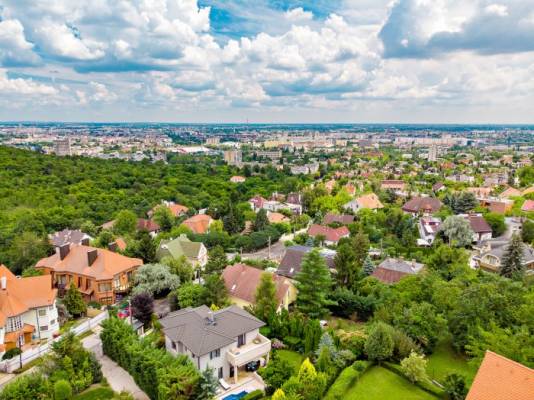
Budapest property market 2026: a change of cycle, not a collapse

After a sharp rise in prices, the Hungarian residential market is slowing in 2026. For BARNES Hungary, this is not a collapse but a change of cycle: buyers are scrutinising prices and property quality more closely, while sellers must adapt to a more selective market. In Budapest, this shift calls for a clear distinction between properties that are genuinely in demand and those whose price no longer matches expectations.
A new political and economic context
The parliamentary elections of April 2026 brought a change of majority after sixteen years of government under Viktor Orbán. The new administration intends to strengthen ties with the European Union and restore confidence with Brussels. This direction could improve institutional predictability, while also implying greater budgetary discipline.
The economic recovery remains modest after several years of weak activity. Investment remains limited and the consolidation of public finances is a central issue. Together, these factors create an environment in which households and businesses may favour caution, without determining on their own how the property market evolves.
The turn of the property cycle
In 2025, Hungarian residential prices rose by around 24% year on year in nominal terms (24.4% in the fourth quarter, according to the latest revision by the MNB, Hungary’s central bank). In 2026, momentum clearly faded: the national index fell by 1.1% in the second quarter, then rose by 0.5% in the third. Year on year, national growth slowed from 12.4% to 6.6%.
In Budapest, prices gained 1.9% in the third quarter after a slight dip in the second, but annual growth continues to slow: 5.3%, against 7.5% the previous quarter.
The subsidised lending programme Otthon Start, which had supported demand since autumn 2025, has just ended: sale contracts had to be signed before 31 October 2026 and loan applications filed before 15 November. It is replaced by Wekerle Plusz, a more targeted scheme for 18-to-41-year-olds, with an obligation to occupy the property as a primary residence for at least five years. At the same time, supply has reached a three-year high, with more than 150,000 listings on ingatlan.com at the end of October, and the MNB notes that sellers asking high prices are more willing to negotiate.
BARNES Hungary’s reading is one of a gradual landing: the price surge belongs to the previous cycle, but the available evidence does not point to a general decline. The withdrawal of public support affects the entry-level segment first; selling times and negotiations will vary significantly depending on the property and its location.
What this means for Budapest
In the prime segment, location, quality and pricing take on particular importance. A property in a sought-after district, with rare qualities and a condition consistent with its price, is not judged by the same criteria as a home whose value rests mainly on expectations of further increases.
District-level data make it possible to refine this reading. According to Lakindex, which aggregates official Budapest sale prices, the estimated sale price stands at around €3,630 per sq m citywide and up to €5,100 per sq m in District V, the most expensive in the capital (accessed 5 November 2026). It reaches around €4,870 per sq m in District I and €4,660 per sq m in District II.
For a seller, the starting price is decisive. In a more attentive and more negotiated market, appropriate positioning from the outset helps attract qualified buyers. A price too far from perceived value can prolong the sale and make discussions more difficult.
For a buyer, negotiation is assessed in light of the property, its quality and its location, as well as the financing available. It is better to evaluate these elements upfront than to base a decision on a presumed future rise. For an investor, the yield and relevance of the property must stand on their own, independently of a mere expectation of capital gain.
In Budapest, a more selective market therefore does not mean that all properties move in the same way. It reinforces the importance of a precise analysis, tailored to the district and to the characteristics of the property. For a valuation or to discuss your project, the BARNES Hungary team is at your disposal.
Morgan Bonin
Managing Partner, BARNES Hungary
Sources
Lakindex, Budapest property prices (accessed 5 November 2026)
MNB, residential property price index, Q3 2026; Q2 2026
Portfolio.hu, 26 October 2026 (MNB Q3 index, revision of the 2025 figure)
Portfolio.hu, 2 November 2026 (supply of properties for sale)
Portfolio.hu, 4 November 2026 (end of Otthon Start, deadlines)
Pénzcentrum, 19 October 2026 (Wekerle Plusz programme)
Comments (0)

No comments, be the first to react to this article!